An illustrative mechanism. The revised improver is installed and used in the next round.
MolP2SBench Molecular discovery
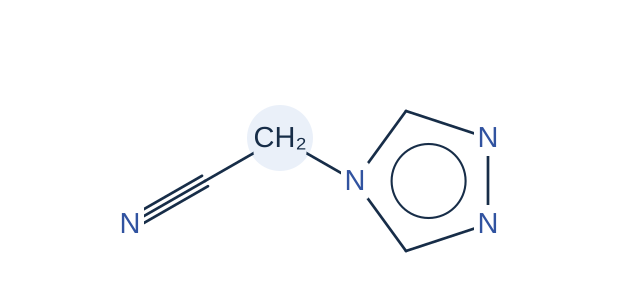
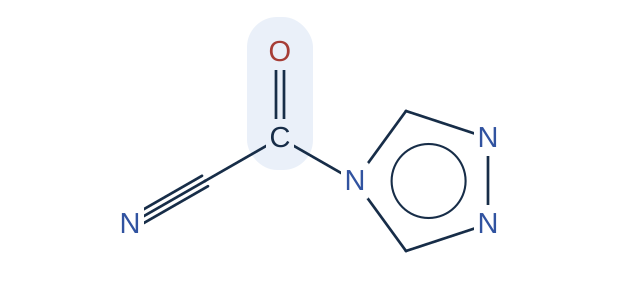
Recover a missing molecular fragment
Hide a fragment of a known structure. Ask a model to recover it using computed physical properties. The original record supplies a reference answer; changing the evidence helps investigate how the model makes its choice.
This is a small, testable part of molecular design. The longer-term question is whether learning from recovery tasks can help a system propose useful molecules.
The demo uses two observations, two candidates and one molecular family. Each property channel in the source has 136 source problems, with two to four candidates per task.
Two questions, the same candidates. Compare each choice with its reference to see where predictions succeed or fail.
Try this exampleOne teaching family · computed dipole magnitudes
What a useful benchmark provides
Scientific discovery involves many possible hypotheses and designs. Better ways to choose the next step may reduce wasted trials. We collect resources that help researchers test those improvements.
Checkable outcomes
A scientific reference or reproducible checker, with a clear account of what it measures.
Useful feedback
Scored outcomes and, where justified, controlled comparisons that help investigate failures.
Fresh problems
Independent scientific families for testing whether a revision transfers.
Repeatable comparisons
Fixed checks, declared feedback access and records of versions, budgets and decisions.
Recursive self-improvement (RSI) uses a system’s current capabilities to improve itself, then brings the updated capabilities into further rounds of improvement. See the mechanism.
A source suggestion can start with a link and example; an independent test set can be developed later.
MASS trains a shared model on selected agent trajectories, then uses the updated model to execute, optimize and evaluate the next round. It connects learning from task experience with later self-improvement.
CISE uses calibrated reward intervals to guide materials search. It addresses a practical dataset question: how can feedback prevent promising-looking but infeasible candidates from steering later trials?
A feedback method for materials search; recursive self-revision is untested.
AIDE² evolves research-agent code. Its separate ignition test puts an evolved agent back into the role of improving agents—the return path that matters for recursive self-improvement.
Later improver reuse was tested; its advantage remains unresolved.
A dataset from one project can become a starting point for someone else. Share original or curated scientific data with checkable outcomes and useful feedback. A paper is optional, and links to existing data sources are welcome.