How would you improve
the next attempt?
MolP2SBench turns known molecule–property records into checkable recovery tasks. Mask a fragment, retain the reference and ask the model to choose a completion. Start with a bounded question about molecular structure, then explore how its feedback could support learning and more open design tasks.
2 observations · 2 candidates · 1 family. A small teaching subset of MolP2SBench. Each property channel has 136 source problems with 2–4 candidates per task. Try the choices yourself, then use the local starter with your own model.
- Choose
- Read feedback
- Diagnose
- Draft a revision
- Plan fresh tests
How does this pair relate to the full benchmark?
MolP2SBench releases three evidence conditions: correct (the original property), shuffled (a property taken from another molecule) and counterfactual (a property corresponding to a different candidate). These conditions vary the evidence attached to a task; they are not three questions or a three-candidate limit. Each property channel of the checked source contains 136 source problems with two to four candidate structures per task. This walkthrough uses two observations—one original and one counterfactual—from one family with two candidates.
The shuffled view is a control scored against the original target. Its role is to test the benefit of correctly paired evidence across cases. The donor value may correspond to none of the listed candidates.
1. Which structure fits the observation?
This teaching subset contains 2 observations, 2 candidates and 1 family. Choose one structure for each dipole magnitude, then check your choices against the reference.
One shared scaffold
The shaded site is the part to complete. Both candidates keep the surrounding structure.
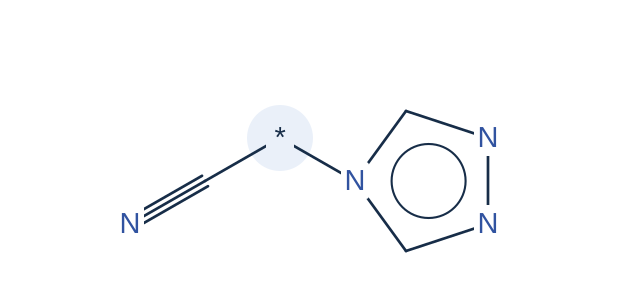
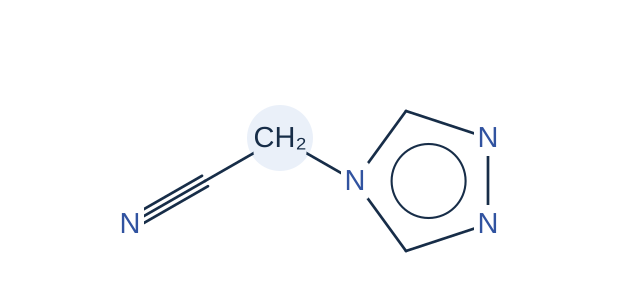
Methylene linkage (–CH₂–)
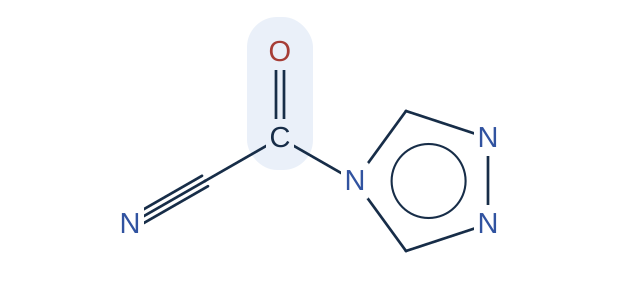
Carbonyl linkage (–C(=O)–)
Observation 1
Source observation
- Your choice
- Reference target
- Candidate 1
–C(=O)–
Observation 2
Counterfactual observation
- Your choice
- Reference target
- Candidate 0
–CH₂–
Your tally covers the two teaching observations in this walkthrough.
Turn this feedback into a plan.
Choose a question, draft a change, then decide how to test it. This walkthrough prepares a plan for your own model and tools.
Diagnose
Save your plan before changing molecular choices or the diagnostic path; either change clears the selected plan.
Choose a possible explanation to test. Each path suggests a revision and a way to check it.
Draft a revision
Optional: revise the improvement method itself
For an RSI study, I denotes your improvement procedure. The proposed change below concerns how that procedure evaluates revisions to your solver.
These are proposed policies. Only permitted development feedback can guide selection. The installed I1 must actually generate, test or select a later solver revision. A proposed policy or an edited file does not establish recursive execution. See the RSI mechanism.
Plan the next test
Next permitted development round
Feedback guides your revision workflow
To prepare: select independent development families and run the planned comparison.
Final protected fresh-family audit
Outside the improvement loop
After development, evaluate the selected, frozen artifact with a fixed external judge on independent fresh-family groups. Do not use audit outcomes to choose or install revisions.
To prepare: obtain fresh families and run the independent assessment after development.
Includes your submitted attempts, public references and selected proposal. The plan records execution and evaluation as pending.
Next: run the local starter with your agent. The starter scores predictions; your own workflow carries out the plan.
Read or copy the plan JSON
Changing either molecular choice or this diagnostic path clears the selected plan. Prior visitor attempts remain in the page-session record.
Inspect the chemical reference and what it can tell us
The candidate reference values
| Candidate | Reference value |
|---|---|
| Candidate 0 | 5.37590 |
| Candidate 1 | 1.45724 |
Computed dipole magnitudes from QM9S at B3LYP/def-TZVP.
This reference table opens after you commit both choices. Keep it with the evaluator when running your own model.
What this pair can teach
The reference targets differ while the candidate set stays fixed. Checking both observations makes the answer pattern visible.
Net dipole depends on molecular geometry and electronic structure together. A rule based only on the presence of a carbonyl group is unreliable. Explaining this pair’s difference requires further chemical analysis.
Source records and limits
- Observation 1: source observation
MCB_QM9_A3_49E99A99315E5E96 - Observation 2: counterfactual observation
MCB_QM9_A3CF_1D2CC3D6DB111D41
- One public teaching family, selected after inspecting a documented failure; not a representative performance sample.
- Labels and feedback are public. Repeating this example after seeing the reference is not a hidden test or evidence of improvement.
- A changed answer is not by itself proof of evidence use; a wrong answer does not identify its cause.
- No model calls, self-modification runs or new molecular calculations are performed by this demo.
An interactive teaching case using your choices. To measure model improvement, run your own system and evaluate its revision on independent families.
A construction recipe from MolP2SBench
Turn known science into
checkable recovery tasks.
The complete structure is known before anything is masked. Hiding a meaningful fragment creates an inference task while preserving an auditable answer. Valid alternatives focus the question on a local structural difference; controlled changes to the properties test how the model uses the evidence.
- 01
Keep the reference
SyComplete structure
Reference stays with the evaluator
+ aligned propertiesBegin with a known molecule and its measured or computed properties. Preserve the source, units and conditions.
- 02
Mask a meaningful part
Visible scaffold + supplied evidenceHide a property-relevant fragment. Keep the surrounding structure and attachment constraints visible.
- 03
Offer valid completions
01Assemble chemically valid alternatives on the same scaffold. Check that the supplied evidence can distinguish them.
- 04
Check the recovery
Selected candidate
compared with
reference targetCorrectIncorrectInvalidScore the choice against the stored target. Keep the scientific inputs, evidence view and outcome in the feedback.
The complete source is represented symbolically here. The masked scaffold and candidates come from the teaching family in this walkthrough; its targets are revealed when you submit your choices.
Feedback a learning process can use
Development labels can support supervised learning or a reward signal for recovery. Comparing matched, omitted, shuffled and counterfactual evidence helps researchers investigate behavior and choose the next test. Evaluate the resulting revisions on independent molecular families.
An RSI study also checks whether the updated capability helps the system make later improvements. Revising and reusing an improvement procedure is one example; researchers supply this loop and test it on fresh scientific cases. What an RSI claim needs.
A recipe others can adapt
Start with an existing scientific record, decide what to hide and keep its reference available for checking. Specify the visible evidence, valid alternatives and diagnostic contrasts. Share one example with its source and reuse terms; we can help develop the task package.
Each task needs a verifiable reference answer or scientific check. A complete canonical reasoning trace is optional; explanations, when provided, need their own checking criteria. The current demo supports scored choices and a revision plan; learning and improvement experiments run in the user’s workflow.
Quality checks before turning a record into a task
Check ambiguity. A known source label and distinguishable candidates are separate requirements. Audit chemical validity, equivalent structures, precision and uncertainty. The MolP2SBench manuscript (Section 3.1; Appendix B.2) describes property-specific separation filters. For a new task, add evidence or define how multiple acceptable answers and indeterminate cases will be handled.
Keep evaluation independent. Group related records, property views and generated descendants before splitting; keep shuffled donor pools within the allowed partition. Release development feedback under a documented policy and reserve final assessment for frozen versions.
Define tool and retrieval access. The source comparison uses task text only. Public property values may allow a database lookup of the answer, so a tool-using extension needs its own access policy and interpretation. Keep protected references outside the solver’s access.
Test evidence use with controls. Correctness, evidence sensitivity and explanation quality need distinct checks. Compare correctly paired recovery, the effect of shuffling and movement toward the specific counterfactual candidate. Use matched cohorts and preserve failures; reference scores verify candidate recovery. Source task and scoring format.
Read the complete construction guide
A construction recipe illustrated by MolP2SBench. This guide describes how to prepare resources for learning and improvement experiments. Researchers supply and run their own models and improvement methods.
The design idea
Start with a complete scientific record whose reference is known. Hide a meaningful part from the solver, retain the evidence needed to infer it, and preserve the reference for checking. MolP2SBench turns structure–property records into local molecular recovery tasks: a masked scaffold, supplied physical properties and a short set of valid completions.
This construction gives an auditable target while concentrating the task on a controlled scientific inference. The target is known to the evaluator before masking. Whether the visible evidence distinguishes that target is a separate scientific check.
Prepare a task family
- Keep a traceable reference. Preserve the complete structure, aligned observations, source version, units, conditions and reuse terms. Distinguish measured, computed and simulated quantities. The website’s dipole example uses computed QM9S values.
- Choose a meaningful mask. Hide a property-relevant connected fragment while retaining the surrounding scaffold and attachment constraints. Document which information the solver receives and keep reference fields out of its input. Declare permitted tools and retrieval: the source benchmark’s closed comparison supplies task text only, without tools, web search or literature retrieval.
- Assemble valid alternatives. Include the source completion and chemically valid, structurally distinct candidates compatible with the scaffold. MolP2SBench uses two to four candidates; its manuscript (Section 3.1 and Appendix B.2) describes property-specific separation checks. Candidate validity and evidence distinguishability require scientific review.
- Define scoring and development feedback. Store the target separately. Report correct and incorrect choices, with diagnostics for missing, malformed or out-of-range outputs, under a fixed scoring policy. Retain the family ID, evidence condition and prediction so outcomes can be compared. Specify when development labels and feedback become available.
- Add controlled views and independent tests. Build scientifically justified interventions, keep all related views and descendants together, and separate development from final assessment before release. Donor pools used for shuffled controls must respect that boundary. Record versions and budgets in the user experiment.
Known reference identity does not establish unique inverse identification over all possible molecules. If the evidence leaves multiple candidates indistinguishable, add evidence, change the candidate set, accept a scientifically justified set of answers, or label the case as indeterminate. Record the treatment and exclusion criteria before evaluation.
Reference answers and explanations
A checkable task must provide a verifiable reference answer, ground-truth label or scientific evaluation rule, together with its source and validation limits. A complete canonical reasoning trace is optional. A contributor can provide an outcome-checkable task without a complete step-by-step solution, but must state what the checker establishes and what remains unchecked.
Reference labels establish candidate recovery; they do not establish the truth of an explanation or reveal why a model chose an answer. When a task also assesses explanations, provide separate reference facts and a declared checking method. Label unverified rationales as hypotheses, and never treat generated text as a validated scientific explanation.
What the evidence controls test
MolP2SBench releases three evidence conditions—correct, shuffled and counterfactual—over the task families. They describe evidence interventions, not the number of questions or candidates. A structure-only comparison is an additional control. The checked source has 136 families with 2–4 candidates per task; the website uses 2 observations and 2 candidates from 1 family.
| View | Construction and scoring | Question |
|---|---|---|
| Correctly paired | Supply the source molecule’s properties; score against its target. | Can the model recover the reference with matched evidence? |
| Structure only | Keep the scaffold and candidates; omit properties; retain the source target. | How much performance comes from structural context alone? |
| Shuffled | Supply properties from another family; retain the source target. | What benefit comes from correct property–structure pairing across cases? |
| Counterfactual | Supply aligned properties of another valid candidate in the same family; update the target to that candidate. | Does recovery track the corresponding change in evidence? |
Keep scaffold, candidate order and evaluation cohort matched across paired views. A shuffled donor may match none of the listed candidates; it is an aggregate control, not an ordinary additional matching question. Report correctly paired recovery together with the effect of shuffling and movement toward the specific counterfactual candidate. A shuffle-related drop plus a donor-directed counterfactual response supports a behavioral evidence-use claim scoped to the tested model and property. Compare source and counterfactual correctness together; simply depressing shuffled performance or changing to an unrelated candidate does not establish better recovery.
How this supports learning and RSI research
Development labels can support supervised learning or a reward signal for candidate recovery. Controlled-view outcomes can help researchers choose diagnostic tests, locate behavioral weaknesses and compare proposed revisions. An outcome score validates the selected candidate; checks on scientific explanations require separate references and criteria.
A researcher can connect the package to a workflow that predicts, scores, tests a failure hypothesis, updates a model or agent, and evaluates on independent families. Improvements measured on exposed examples must remain separate from transfer results. Record failed attempts, regressions and total cost alongside successful changes.
An RSI study also checks whether an updated capability helps the system make later improvements. One stronger test under the draft protocol updates the procedure that proposes or selects improvements and uses that updated procedure again. Compare old and new procedures from common starting systems and budgets, and compare full runs against a fixed-procedure control. This resource design supports those experiments; it does not establish their outcome.
Adapt the recipe to your research
The reusable pattern is known record → meaningful missing information → justified alternatives → verifiable recovery → controlled feedback. Candidate extensions include recovering a missing equation term from a documented dynamical system, or identifying a local material-structure completion from measured properties. These are proposed applications; each needs its own identifiability, validity and leakage checks.
Begin a contribution with one representative record, what would be hidden, which evidence would remain, how candidates and targets would be constructed, and what the checker would verify. Include the original paper or source, reuse terms and a grouping plan. Partial resources can enter the resource-review route before a complete task package exists. Automatic format checks precede human scientific, usability and rights review.
Audit answer lookup separately from scientific ambiguity. Public property values can act as database lookup keys; returning a stored source structure then tests a different capability from inferring a completion from the allowed evidence. For a tool-using extension, declare permitted scientific computation and retrieval, isolate protected references, and record access. Keep its results distinct from the source task-only comparison. Public records can also have appeared in model training; grouping alone cannot establish absence of prior exposure.
Source and current scope
Benchmark paper and task design: Yuhang Xie, Zhiyi Shi, Zeyi Zhang, Zhisheng Qi, Yushun Dong, Yu Wang, and Xiongye Xiao (2026). MolP2SBench: Do LLMs Really Reason from Molecular Properties to Structure?. arXiv:2610.12522.
Underlying molecular property source: Zihan Zou et al. (2023). A deep learning model for predicting selected organic molecular spectra. Nature Computational Science 3, 957–964. Identify the QM9S dataset release used as well. These attributions serve different roles; citing the benchmark does not replace attribution of the underlying data.
- MolP2SBench source and task format, pinned for this illustration. The accompanying manuscript describes masking and candidate construction in Sections 3.1–3.2 and Appendix B.
- The website walkthrough contains two observations and two candidates from one teaching family. It provides choice feedback and a proposed revision/test plan; the downloadable starter scores a user’s model predictions. Independent evaluation families and controlled RSI results remain future work.
- Follow the original data and benchmark reuse terms. This platform’s teaching adaptation is shared with project-lead authorization. Original source terms remain separate; this grants no blanket license to the full upstream benchmark.
From recovery to molecular design.
The aim is to help AI reason about how molecular structure determines properties, and eventually propose useful molecules. We start with a question whose answer can be checked.
- Current benchmark
Recover a structure
Choose a missing fragment using property evidence. Check the reference and examine how choices respond when the evidence changes.
- A study to build
Learn from the feedback
Use development cases to train or revise a solver. Evaluate the change on independent molecular families.
- Longer-term research
Generate and verify
Test whether those gains transfer to proposing structures without a candidate list, under explicit property constraints.
Transfer to generation remains an open research question. Generated molecules need separate checks for chemical validity, target properties and novelty; experimental usefulness requires further validation.
Measurement plan and available data
Property-Grounded Recovery (PGR)
Average these family scores equally within each property channel. Count invalid outputs as failures. This walkthrough reports your two choices separately.
Coverage at the checked commit
Dipole has 136 source problems, with 120 complete source–counterfactual families. Use the same eligible family cohort for every solver version.
The public source supplies molecular inputs, separate labels, matched interventions and an exact-match scorer. The local starter adds a two-case input and feedback interface. Family metrics, recorded model baselines, an executable revision loop, independent chemical checks and fresh confirmation data remain research work.
Source and citation
Benchmark paper. Yuhang Xie, Zhiyi Shi, Zeyi Zhang, Zhisheng Qi, Yushun Dong, Yu Wang, Xiongye Xiao. MolP2SBench: Do LLMs Really Reason from Molecular Properties to Structure? arXiv:2610.12522 (2026).
Cite this resource
Cite the benchmark paper for MolP2SBench tasks and design. For QM9S-derived records, also cite the underlying QM9S paper and identify the dataset release used. Each source has its own reuse terms. A deep learning model for predicting selected organic molecular spectra · QM9S dataset release.
Select and copy the entries below, or download the BibTeX file above.
@misc{xie2026molp2sbench,
  title = {MolP2SBench: Do LLMs Really Reason from Molecular Properties to Structure?},
  author = {Yuhang Xie and Zhiyi Shi and Zeyi Zhang and Zhisheng Qi and Yushun Dong and Yu Wang and Xiongye Xiao},
  year = {2026},
  eprint = {2610.12522},
  archivePrefix = {arXiv},
  primaryClass = {physics.chem-ph},
  url = {https://arxiv.org/abs/2610.12522}
}

@article{zou2023molecularspectra,
  title = {A deep learning model for predicting selected organic molecular spectra},
  author = {Zihan Zou and Yujin Zhang and Lijun Liang and Mingzhi Wei and Jiancai Leng and Jun Jiang and Yi Luo and Wei Hu},
  journal = {Nature Computational Science},
  year = {2023},
  volume = {3},
  pages = {957--964},
  doi = {10.1038/s43588-023-00550-y},
  url = {https://doi.org/10.1038/s43588-023-00550-y}
}
Source, provenance and reuse notes
Example records come from DUAL-Xiao/MolP2SBench at commit 1ede82b. Values are computed QM9S dipole magnitudes, with method and units retained from the records. This teaching case was selected from a documented failure in the source paper.
The underlying QM9S release lists CC BY 4.0; cite its original paper. The checked MolP2SBench repository has no standalone license file. This platform’s teaching adaptation is shared with project-lead authorization. Original source terms remain separate; this grants no blanket license to the full upstream benchmark. Teaching case with answers and provenance.